Author Archives: Mike Kuper

Cigars and Stars

Another month has flown by – we’re only a week away from Halloween! October began with Donna taking a trip to Bennington, Vermont to visit her parents. I drove Donna to the airport in the early morning of Tuesday, October 3rd. I had time after dropping her off for a quick breakfast and coffee before sunrise. Then I packed my photography gear and headed over to the Riparian Preserve in Gilbert. The first hour or so after sunrise usually has great light for photography.

I shot a few bird photos that I thought were nice. This hummingbird is puffed up, warming herself in the sunrise.

Female hummingbird

I shot a sequence of a snowy egret skimming the water and capturing a fish for breakfast.

The third photo of the sequence above shows the nice early morning light on the back of the egret’s wings. I also captured an image of cormorants in flight.

The cormorants are flying toward the sunrise and the light on their underside is very nice.

The glassy water reflects the image of these black-neck stilts.

Black-neck stilts

I also liked the simple composition of this black phoebe photo.

Black phoebe

Friday, October 6th was my birthday. Donna was away, but she left me a card with a gift certificate for RJ’s Cigars. This was just right as I planned to go to RJ’s Cigar Lounge and enjoy a top-shelf cigar for my birthday. I also want to give a shout out and thank you to long-time blog follower, Miriam Armbrester. Miriam sent me a birthday card. I really appreciate the fact that she took the time to select a card and send it to me in the mail. We met Miriam and her husband, Rand, when we were in Alabama in 2018. They treated us to lunch at the oldest restaurant in Alabama – I wrote about it here.

Donna came back from Vermont on Sunday, October 8th. During the month of October and into November, many of the winter snowbirds return to Viewpoint. Residents of the northern states and Canada return as the weather here cools and becomes downright cold in the areas they summer in. We’ve had slightly cooler weather with a few exceptions where we had very warm afternoons. The evenings are pleasant and overnights are much cooler now.

My last attempt at astrophotography was on our trip to our housesit in Cortez, Colorado. I was foiled by clouds there. The summer months of July through September were too hot here for astrophotography. Here’s the thing – I use dedicated astrophotogrphy cameras for deep sky objects. These cameras have electronically cooled sensors to capture the image.

Deep sky objects are so dim and so far away that long exposure times are necessary. If the image sensor gets too hot, it creates noise – that is, random pixels will glow in uncontrolled ways, making the image appear grainy and lack clarity. For deep sky photography, I like to maintain the sensor temperature at zero degrees Celsius (32 degrees Fahrenheit). My best camera is able to cool the sensor 35 degrees Celsius below the ambient temperature – others are capable of cooling 30 degrees Celsius below ambient.

In the summer here, it’s not uncommon for the ambient temperature to remain above 90 degrees (about 30 degrees Celsius) well after dark. This would mean my camera’s cooling system would have to run at 100% output continuously to try and cool the sensor enough. I don’t like to run it above 50% and once cool, it should maintain the temperature with about 25% output. Thus, I give up astrophotography here in the summer. I could photograph planets or the moon. These are such bright objects, they can be captured with very short exposures and do not need cooling. But I find it hard to motivate myself to set up my gear when it’s hot outside and doesn’t get dark until after 9pm.

Lately, the temperature has been dropping to around 80 degrees shortly after sunset. I still have some new gear that I bought earlier this summer, but haven’t been able to try out. While Donna was away, I set up here at the Northpoint Recreation Center in the Viewpoint Resort. I used my Player One Poseidon astro-camera for the first time. I had some technical difficulties the first night and had to give up. I went back out on October 4th and captured just short of three hours of usable 75 second sub-exposures. This is the Andromeda Galaxy, one of the first deep sky targets I attempted when I got into this hobby about 10 months ago. This is an improvement over my earlier attempt, but it needs more time to reveal the detail.

Andromeda Galaxy (M31)

Although this galaxy is over two million light years away from earth, it’s the closest galaxy to our own Milky Way galaxy.

I mentioned technical difficulties – they hit again the next time I went out. I was very frustrated and finally figured the laptop I was using, which was a refurbished unit I bought on Amazon had signs of impending hard drive failure. I bit the bullet and went to Best Buy and bought a better laptop with a 1TB solid state drive.

Unfortunately, the new laptop was loaded with Windows 11 – the old one was Windows 10. Most of the astrophotography open source (free) software I use was developed for Windows 10. I had to download all of the software programs and reconfigure everything. Some software, NINA for example, had to have new paths configured to communicate with other needed programs. NINA manages my session, communicating with as many as four other programs simultaneously. I’m not that computer savvy and it took a lot frustrating trial and error to get it working.

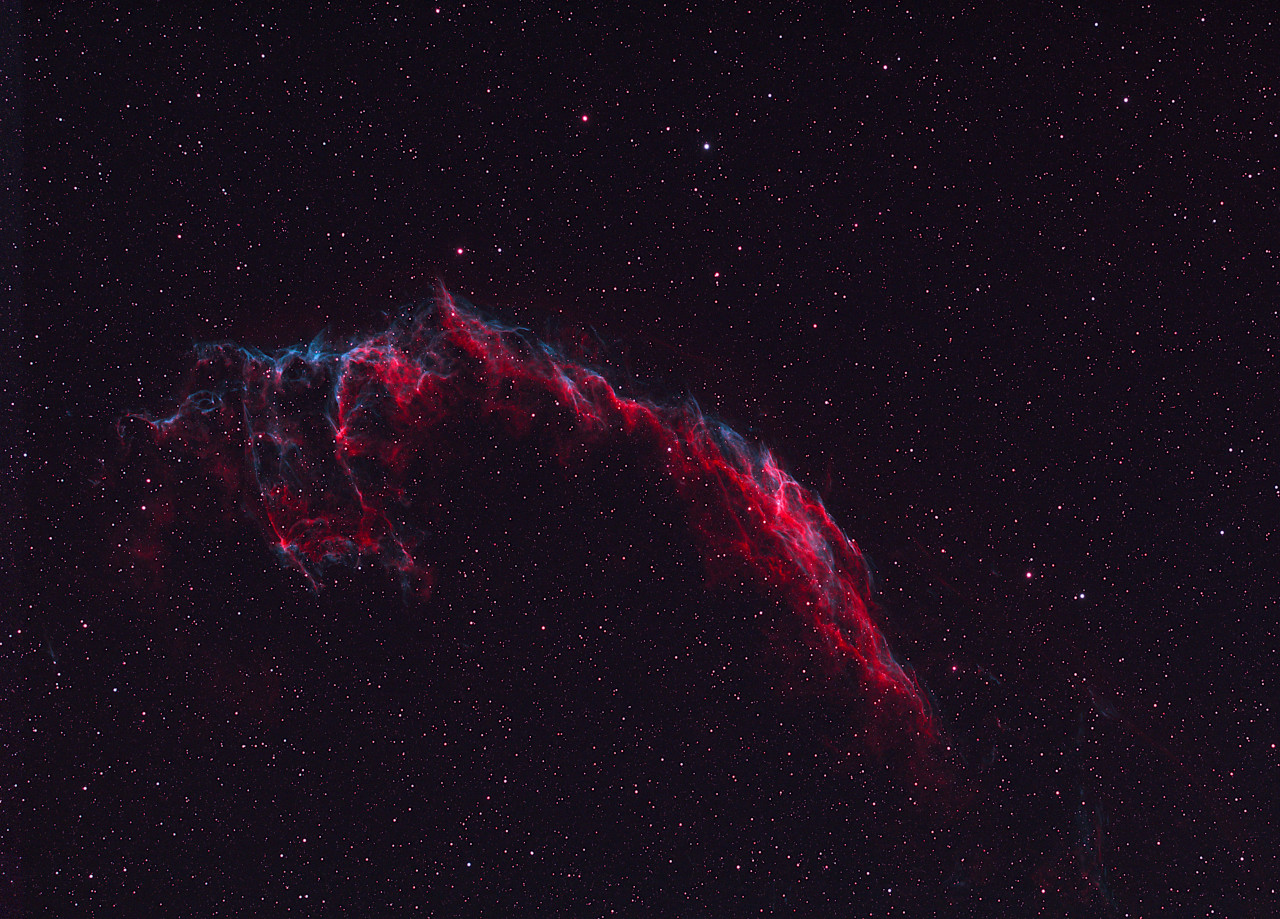
I’ve wanted to capture an image of the Eastern Veil Nebula for a while – it was to be my target when we were in Cortez, Colorado. It’s getting a little late in the year, but I went for it. My first session was full of technical issues that resulted in only 76 minutes of usable data.

After finally getting all of my gear and software to play nice, I added two more sessions for a total time of four hours and 23 minutes. This produced a nicely detailed view with vibrant, saturated color. The red areas are hydrogen gas and the blue is oxygen.

Eastern Veil Nebula (NGC6992)

The Eastern Veil Nebula is located in the constellation Cygnus. It’s part of a large supernova complex called the Cynus Loop. The entire loop is quite large with distinct areas of gas created when a large star (20 times the size of our sun) died. When stars die (supernova) the outer areas explode away from the core creating these vast clouds of gas, while the core implodes into a high density mass that may become a black hole.

In the photo above, you can see traces of hydrogen throughout, leaving a reddish cast. I might try to capture more of the Cynus Loop – the Western Veil and Pickering’s Triangle.

With Donna back home again, I’ve enjoyed some gourmet dinners. First I’ll share the sheet-pan chicken with shallots and grapes. Served over spaghetti squash, it was an interesting and delicious dish.

Sheet-pan chicken with shallots and grapes

Another goody was creamy scallops with fresh tomatoes.

Creamy scallops with fresh tomatoes and steamed spinach on the side

Although the thermometer flirted with 100 degrees last week, the week ahead and into November calls for highs in the low 80s and eventually down to the 70s. Looking forward to that!

San Diego Housesit

My last post mentioned my desire to get back into terrestial photography in addition to my astrophotography hobby. I’m particularly interested in bird and wildlife photography. I put together a modest kit with a Canon R7 camera body and a few lenses – most useful are the 100-400mm zoom and a 600mm prime lens.

I didn’t go all out on professional level Canon “L” glass – the costs are prohibitive. The consumer-grade Canon lens has advantages and disadvantages. The advantages include, obviously, lower cost. They are also compact and lighter weight. The main disadvantage is the smaller maximum aperture, resulting in slower lens speed – meaning they can’t gather as much light as a faster lens. This is a problem in lower light with fast moving subjects. The “L” lens line generally has better autofocus capability and image stabilization. That’s not to say the consumer-grade line up has “bad” autofocus and image stabilization – it’s pretty amazing in fact.

My first bird photo opportunity came right in our backyard – the fifth hole of the Viewpoint Executive nine-hole golf course. There’s an established breeding colony of non-native Lovebirds here. Donna and I found them in a palm tree.

Rosy-faced Lovebirds

We had a housesit lined up for September 18th through the 27th in San Diego. I knew there would be many opportunities in San DIego for bird photography, especially shore birds. I started practicing my skills before we went there by visiting the Gilbert Riparian Preserve – it’s about 10 miles away from our place at Viewpoint in Mesa.

The riparian preserve is located in east Gilbert on 110 acres of land. Of the 110 acres, 70 are covered by a series of seven ponds (water recharge basins). It’s mostly wooded with several trails throughout the preserve. Many common shore birds such as egrets and herons as well as waterfowl and osprey can be found there. The woods are home to many other species of birds.

Female adult Great-tailed Grackle

While confirming the identity of some birds, I found a curious fact. Some bird names have changed over the years. I remembered Great-tailed grackles as Boat-tail Grackles. I checked my old copy of Peterson’s Field Guide to Western Birds and sure enough, it’s called a Boat-Tail grackle. My new copy of Peterson Field Guide to Birds of Western North America lists the same bird as a Great-Tailed Grackle.

Snowy Egret
Great Egret

Note the black bill and yellow feet on the Snowy Egret while the Great Egret has the opposite – yellow bill and black feet.

Hummingbird in the woods
Osprey – sometimes called a Fish Hawk
Green Heron nabbing a small fish
Swallowed it in one gulp

The homeowner in San Diego asked us to arrive there between 3pm and 4pm. We left Mesa, Arizona at 8am to allow plenty of time to make the 400-mile drive to San Diego. I stopped in Yuma, Arizona to fill our gas tank. Regular unleaded gasoline was $4.14/gallon there. Crossing the Colorado River and entering California, the fuel prices were nearly $2/gallon higher!

California gas cash price at Speedway – the prices were rising during our stay

We arrived at our destination in the Clairemont neighborhood right at 3pm. After spending an hour or so getting familiar with the home and Sadie, their German Shepard, we found out the homeowner wasn’t leaving for the airport until 8pm. We drove down to Mission Bay and parked outside of the Mission Bay RV Resort to look around and kill some time. We used to spend the fall here when we were full-time RVers. The place has really changed.

All of the old park model homes have been removed. The clubhouse is still there and now the swimming pool is open to RVers staying in the park. The park is no longer secured – walking and biking paths through the RV park are open to the public. I would be very concerned about theft in the RV park nowadays – it was bad enough when it was all gated and patrolled.

Donna and I hiked around the point defining De Anza Cove and I photographed a few birds.

Great Blue Heron

I found a shorebird I didn’t recognize on the south side of the point and shot a few frames.

Mystery bird

I uploaded the image into Google Images and it came back with a match to a Reddish Egret. I did a search and found these are fairly rare in southern California – only three or four are reported each year and fewer are documented with photographs. I contacted the San Diego Audobon Society and they asked for photos. I sent them the files. They got back to me and told me I had mis-identified the bird. It wasn’t a Reddish Egret, it was a Little Blue Heron and they were pretty excited about it. Finding one on the west coast north of Mexico is extremely rare and I had it documented! The coloration of the bill positively identified it – I should have caught that.

The next day, we drove up to La Jolla and walked around the La Jolla Cove. I called it a target-rich environment. There are many bird and mammals that are easily accessible there. Pelicans are ubiquitous.

California Brown Pelican coming in for a water landing

The Children’s Pool area is over-run with sea lions and seals.

The old man presiding over snoozing sea lion pups
This sea lion pup is napping with one eye open
Gull in flight

I had plenty of opportunities to practice capturing birds in flight.

Later that evening, we returned to La Jolla after taking care of Sadie, to join Donna’s sister, Sheila and Jeff for dinner and had a nice night. Donna walked Sadie two or three times each day while we were there.

The next morning, I drove to the San Diego River estuary along old Sea World Drive. The lighting conditions each morning were challenging. There was a marine layer overcast – while that provided a diffuse light source with minimal shadows, it also limited the brightness. I found a couple of interesting birds along with more egrets. In hindsight, I wish I would have switched to my 600mm lens, but I stuck with the faster 100-400mm zoom.

Adult female Belted Kingfisher

As I was loading my gear in the car, I spotted a large raptor in the sky headed in my direction. It landed at the top of a pine tree next to the road. I quickly got my camera out of the car and grabbed a few shots. Right away, I thought “Marsh Hawk.”

Once again, Google Images told me I had it wrong. It was identified as a Northern Harrier. I couldn’t find a Marsh Hawk image. After searching further on the internet, I found the Northern Harriers were formerly called Marsh Hawks! Fooled by another name change.

On Friday afternoon, we met up with my high school buddies, Gary Stemple and John Barrientez at the Riverwalk golf course in Mission Valley. I don’t think I mentioned the house where we were house-sitting was located less than a mile away from Clairemont High School and Marston Junior High where I went to school in the early ’70s.

Gary, Donna and John at Riverwalk golf course

I rode along for the first nine holes, then headed back to attend to Sadie. This was a tough golf course with some long 500 yard+ holes with the San Diego River crossing some fairways. It took them about five hours for 18 holes.

We had a couple of dinners at my old watering hole, Offshore Tavern and Grill where we met up with some of the old crowd and had our favorite dinners of poke and seared ahi. We met up with Mona Sojot one night – it was great to see her again and see how well she’s doing. Donna also met with Sini one night for a walk at Mission Bay and dinner at Offshore.

We played pickleball one afternoon as guests of Sheila and Jeff at the private San Diego Tennis Racquet Club. We played four games and it was enjoyable, although I was a bit rusty. I’ll be giving pickleball lessons over the winter here at Viewpoint again.

We made two more morning hikes to photograph birds. We went to Cabrillo National Monument and drove down to the Point Loma tide pools. I caught a couple of shots of pelicans surfing. That’s what I call it when a pelican glides on the column of air being pushed along as a wave comes ashore. They glide close to the water’s surface for long distances this way.

Pelican surfing
A squadron of brown pelicans heading my way
Cormorant
Cabrillo Historic lighthouse – viewed from below at the tide pools near the new Point Loma lighthouse
House Sparrow on a pier on Shelter Island
A pelican splashes down after diving 40 feet though the air to capture a fish

Our last birding stop was a morning hike through Tecolote Canyon. I found a few interesting subjects to photograph there.

California Thrasher
Mannekin in Tecolote Canyon – non-native but well established in San Diego
Woodpecker
California Ground Squirrel

I’m working with new (to me) software to “develop” and process my images. It’s different from astrophotography image processing. I’m mainly using a program called DarkTable which is very powerful, but I’m finding it complicated. My images out of the camera aren’t bad, but as my processing skill improves, I expect better results.

We drove home uneventfully on Wednesday, September 27th. We made our usual stop at Dateland and bought date shakes and Donna picked up a few packages of dates. We hit some traffic as we neared Mesa as the evening rush hour was in full swing.

No dinner plates this time. It looks like we’ve finally beat the heat as the forecast is calling for cooler tempertures with the highs in the 80s and 90s for the week ahead.

Cortez Housesit

Another month is history as time marches onward. August wasn’t very eventful here – it’s the hottest month of the year and this year we had very little monsoon activity. I spent an inordinate amount of time indoors, enjoying the cool air conditioning.

Donna gets out to golf at least once a week and also plays tennis three times a week in the early morning hours. When she golfs the nine-hole course, I usually sit on the back deck with a cup of coffee about 45 or 50 minutes after her tee time. I use an old pair of cheap Bushnell binoculars and pick her up on the fourth hole green, then watch as she hits the fifth hole right behind our place.

After doing that one morning, I had a wild idea about upgrading to a decent pair of binoculars. I looked online for a couple of days, then decided I needed to have a hands-on comparison. So I drove over to Bass Pro Shop near Dobson Road and the Loop 202 in northwest Mesa. Mesa is a big city – nearly 140 square miles and it’s the third largest in Arizona by population after Phoenix and Tucson. I’m getting off track – I meant to say it’s about an 18-mile drive from Viewpoint in east Mesa to Bass Pro in northwest Mesa.

The optics department in the Bass Pro Shop is on the second floor on the east side. I was able to handle and look through a number of binoculars. On the upper west wall of the store are a series of windows – the clerk told me it’s 91 yards from the optics counter to the west wall. That’s right – you could fit a football field inside of the store! He then told me I should look through the second window from the left and find a large white house with a red tile roof on Camelback Mountain. That house was just over eight miles away.

I was astounded! With all of the binoculars I sampled, I could focus through a window 91 yards away and get detail on the house eight miles away! I was mainly interested in 8X (eight power – the views appear eight times closer than the actual distance). I also tried 10X. For me, 10X is pushing it. Although it makes objects appear closer than 8X and can provide more detail, this is offset by my inability to hold the larger binocular steady enough to take advantage of any detail improvement.

I tried a few different brands and price ranges. I was tempted to break the bank on a high-end set, but kept my sanity. I found that once I reached a certain quality level, any improvements were incremental. Spending twice as much didn’t make the view twice as good to my eye. I ended up buying 8X42 Vortex binoculars that are light years ahead of the Bushnell binoculars I was using.

I took the binoculars out at night and could see surprising detail on the moon. Not on the same level as my telescopes, but better than I expected.

We had a housesit scheduled at the end of the month in Cortez, Colorado. It’s about a 400-mile drive from Mesa. The homeowner wanted us to arrive around 10:30 or 11:00 am on Thursday, August 31st. That would mean a dark-thirty departure, so we opted to leave on Wednesday and stop halfway in Gallup, New Mexico. I loaded the Jeep Compass with my astronomy gear – I took my Astro-Tech AT115EDT telescope and Losmandy mount. I had a target in mind for the dark skies we anticipated at the property outside of town. I also brought my binoculars.

We left around 9:15 am and made it to the Royal Holiday Motel in Gallup around 3 pm – we’d lost an hour crossing into Mountain Daylight Time at the New Mexico border. Gallup can be a rough-and-tumble town. We were on the west side along Route 66, a boulevard lined with motels. We drove downtown and had dinner at a diner with traditional New Mexico cuisine. After dinner, we went to the historic Hotel el Rancho for a cocktail.

The Hotel el Rancho has been in Gallup since the 1940s and many film stars have hung their hat there while making movies in locations nearby. Hollywood stars including John Wayne, Robert Mitchum, Spencer Tracy, Katherine Hepburn, Kirk Douglas, Gregory Peck and Suzanna Pleschette have stayed there. More recently Emilio Estevez, Lou Diamond Phillips and Kiefer Sutherland and others were there to film Young Guns II. They had many framed photographs and memorabilia on display. The lobby was classic with twin curving staircases on the left and right leading up to a second floor landing. The wood work is grand.

Historic Hotel el Rancho
el Rancho lobby

The Royal Holiday Motel where we stayed advertised free continental breakfast – it’s a lie. Unless you call Cheerios and white bread and a toaster continental breakfast. We passed and headed out before 8am and grabbed a quick bite at McDonald’s in Walmart. I also needed to pick up eye drops and Flonase for pollen allergies which I forgot to pack.

We arrived at the home outside of Cortez right at 11am. Diane, the homeowner gave us a tour and instructions on the care of her two dogs, Charlie and Zuni. The dogs were adorable – well-mannered and a joy to take care of. The property was on four acres in a sparsly populated area northwest of town. The nearest neighbor was a quarter of a mile away. Once we settled in, I set up my telescope.

Telescope under cover on the east side of the property

I had the telescope protected from dust or rain under a cover that also reflects sunlight off of it. I made a couple of changes to my set-up. This isn’t the best way to go – I usually try to only change one thing at a time in case I have problems and need to troubleshoot. If you change multiple pieces in the set-up, it can lead to confusing results. I was using a new camera – a Player One Poseidon C. This has an APS-C size sensor which is larger than what I used previously. I also changed the field flattener from a TS 1.0x to an Astro-Tech 0.8x. The 0.8x means it’s a focal length reducer, resulting in a wider field of view. The wide field along with the larger sensor would allow me to frame my target to best advantage. I was targeting the Eastern Veil Nebula.

I got things rolling after dark and completed the calibration process fairly quickly. Then I had to find focus with the new set-up. I ran into a snag. I couldn’t get a focused image of the stars. I was perplexed and started putting in spacers to increase the back-focus length. I couldn’t get it. I finally discovered the problem was a light leak in the Player One filter drawer creating reflections – another new piece of equipment.

Once I fixed the light leak, I decided it would be easier if I focused on the bright, full moon. Then I could fine-focus on stars. I slewed to the moon and took a test shot. It was so far from focus I was lost again. Then I looked up at the moon. It was obscured by clouds! Clouds had rolled in while I was fiddling with my equipment and I didn’t even notice. I covered the ‘scope and called it a night.

I’ve always said astrophotography teaches you patience. I had to be patient and try again the next night. Friday had partly cloudy skies all day and it was worse after dark. The next lesson I’ve learned from astrophotography is acceptance – accept the things that are out of your control and cannot be changed. So I waited for Saturday night. Clouds again. My telescope never came out from under the cover and I took it down on Sunday night and packed it in the Jeep for Monday’s departure.

View to the northeast from the second story deck
View to the south from the upper deck

The house had two hummingbird feeders on the upper deck. It also had two bird feeders in the back garden area. I enjoyed sitting on the lower deck area and puffing on a cigar while I used my binoculars to bird watch. With the clear detailed views provided by the binoculars, I could easily distinguish the markings and positively identify a Woodson’s Jay. It was easy to tell it apart from the Pinon Jays that also came to feeders. The sparrows were harder to identify. Not only are there many similar species, there are also many variations of color and to a degree, markings on what is called the same bird. House sparrows are a case in point. I really enjoyed the bird watching.

Donna enjoyed daily morning walks with the dogs. Charlie was super-easy and would approach me wherever I was and put his head on my knee waiting for me to scratch his head and ears. Zuni took a couple of days to warm up to me, but then she would lay at my feet wherever I was sitting.

On Saturday, Donna and I drove into town for the Farmers’ Market. We also went to the grand opening of the Pueblo Seed Company store where Donna purchased a few items.

Pueblo Seed Company bounty

We departed from Cortez on Monday, September 4th – Labor Day. I anticipated about a six-hour drive time. We retraced our route down US491 through the Navajo Nation to Gallup, then west on I-40 to Holbrook where we exited onto AZ377. I blinked and missed the gas station in Holbrook and decided to continue on to Heber-Overgaard. This went against my grain – I don’t like to run below a quarter tank of fuel, I like to keep about 100-mile reserve. We went below a quarter tank before we reached Heber-Overgaard.

We found a Subway sandwich shop in Heber-Overgaard and I also filled our gas tank there. We gained an hour crossing into Arizona which maintains Mountain Standard Time year-round. We went west on AZ260 toward Payson. The traffic was heavier than usual, due to the holiday long weekend. Donna saw a traffic alert on her phone.

AZ260 goes from four lanes (two in each direction) to two lanes a couple of miles east of Star Valley. This constriction was a choke point that brought traffic to a standstill. We crept along, bumper-to-bumper from there until we made it through Payson. It took two hours to cover about 10 miles! Remember what I said about learning acceptance. I kept my cool as we crept along. Once we were past Payson on Highway 87, I lost my patience along with everyone else as we sped along in excess of 80mph. My six-hour drive turned into nine hours.

A few days ago, I was thinking about how much I enjoyed the bird watching. When I was a kid, my late brother Ricky and I often went bird watching in the woods by Lake Whitehurst in Norfolk, Virginia. We also did it when we lived in Waukeegan, Illinois. I could identify many more birds then than I can remember now.

I also thought about how much photography I used to do. I took a semester of Photography at Palomar College in San Marcos, California in 1981. In the late ’90s, I transitioned to digital photography and invested a lot in camera bodies, lenses and lighting equipment. I did high school sports photography when my daughters were in school and a local paper published many of my photos. I’ve maintained photos on a web host called Pbase.com since then.

My photography gear is long outdated as I’ve only used cell phone pictures for the last decade. I decided to take up the hobby again. When I’m not doing astrophotography at night, I intend to try bird and wildlife photography during the day. After a bit of research, I went for a mirrorless digital camera body from Canon. I had a bit of serendipity. I phoned B&H Photo in New York where I used to buy much of my gear. They had an unadvertised special on the camera and lenses that I wanted. Canon sets a minimum advertised price (MAP) on its retailers. But for B&H’s 50th anniversary, they had a special event called Bild50 and applied additional discounts when I placed my order. I saved $550 over the online price and had free overnight shipping to boot! Now I’m on another learning curve as I wade through the menus on my Canon R7 and try to optimize the set-up.

I’ll close this long post with a couple of dinner plates. First is a pan-seared pork chop with garlic and spices, served with roasted baby potatoes and asparagus.

Next we have Donna’s crab cake served with a corn, tomato, onion and avocado salad.

On the 18th of this month, we’ll be heading out for another house sit. This time we’ll be in San Diego in the neighborhood where I went to junior high and high school – Clairemont. We have a nine-day housesit and I’m looking forward to photographing shore birds at the beach. I won’t take astrophotography gear as we’ll be in the middle of the San Diego metro light-dome.

Hot Times

July was mostly uneventful as the weather warmed up in the Valley of the Sun. As expected, it became downright hot in the metro-Phoenix area. Of course, the media sensationalized the hot weather, claiming a record number of days over 110 degrees. The Weather Channel almanac recorded a total of 20 days of highs of 110 or higher in Mesa for the month of July, including a stretch of 17 consecutive days starting on the 13th of July.

I don’t know where they record the official metro temperature for recordkeeping, but I imagine it’s somewhere in the concrete jungle near the Phoenix city center. There was also a lot of talk about the nighttime lows staying the 90s. I think some of this has to be attributed to the amount of desert that’s been paved over and the amount of concrete poured for various buildings over the last couple of years. This retains a lot of heat – more than the open desert.

With all of that in mind, a look at the almanac also shows that these high temperatures aren’t that unusual – it’s always hot here in July and August. The “record” number of consecutive days over 110 were set because we didn’t have “breaks” where the thermometer only hit 108 or 109.

The most unusual thing I’ve observed this summer is the lack of monsoon activity by this time of year. The southwest has a monsoon season the begins mid-June and extends through the end of September. The monsoon is characterized by intense thunderstorms, higher humidity and high winds. This weather pattern comes from moisture brought up from the west coast of Mexico and is strongest in Arizona although it also affects southern California, parts of Utah, Colorado and New Mexico.

Thunderheads and lightning have been visible over the Superstition Mountains from our place in Mesa, Arizona, but we’ve had very little rainfall and only a few windstorms with blowing dust. Much less activity than we normally see.

The hot weather curtailed much of the acitivity around here. In July, Donna continued to play tennis, starting at 6:30am to beat the heat and she also golfed early. I’ve given up pickleball for this stretch. Astrophotography is out of the question until temperatures cool or when we do our next housesit in a cooler climate.

In previous posts, I mentioned trouble with the swamp cooler in our Arizona room. The pump quit working and I replaced it. The drive belt for the squirrel cage fan also needed to be replaced. The new belt didn’t last – it quickly slipped and burned up. The guy at the Weather Shack told me I had the belt set too tight – it needs a certain amount of slack to work properly. I replaced it again and set it how he had instructed. Then the cooler quit working and I found the root cause of the drive belt troubles. The shaft bearings in the fan were shot and finally seized.

I thought about replacing the swamp cooler with a new one as it had served us well. There were drawbacks though. The main issue is high humidity in the monsoon season. Swamp coolers are most effective with dry air and lose their effectiveness as humidity rises. A replacement cooler would run about $2,500 plus installation.

I went to the Weather Shack and looked at alternatives. Specifically I was interested in looking at a ductless mini-split heat pump. Another alternative would be to add ducting from our existing heat pump to the Arizona room, but that had drawbacks as well. It would mean running ducting through the crawlspace and putting in floor vents. Additionally it would also require a return duct to circulate the air back though the evaporator housing. This would reduce our limited floor space. It would also cost about $2,500.

A mini-split ductless system splits the air conditioning unit or heat pump into two separate elements. You have the compressor and condenser unit that is situated outside of the house. From there copper tubes carry the refrigerant into the house to the evaporator and interior fan unit. This splits the cooling (or heating) unit from the blower assembly with only a couple of hoses joining the two with no need for ducting.

I wasn’t sure of what size unit I would need for our 400-square-foot Arizona room and I was also skeptical of making it a do-it-yourself project. It would require a few special tools and equipment to do it properly. The guy at Weather Shack gave me contact information for a guy he recommended for installation, Dan Shroeder. I called him right away and he stopped by later that afternoon.

He looked the Arizona room over and checked how much heat was coming from the ceiling. The metal roof over the Arizona room was surprisingly cool, due to the Cool Foam installation I had done last year. Although it was 114 degrees outside with full sun on the roof, inside we could place our hands on the ceiling and it wasn’t hot. He said a one-ton unit was all I needed. He said if I bought the mini-split heat pump from the Weather Shack, he could do the installation the following day, Friday, July 14th.

The Weather Shack had a stack of Hessaire mini-split heat pumps on sale. I bought the one-ton heat pump kit for $532 including tax. This was an unbelievable deal – Home Depot wanted nearly $900 for the same unit. Dan showed up with a helper the following morning and did an excellent job. He had it up and running shortly after noon.

He told me the main failure point on mini-split systems is the connectors of the refrigerant tubing. He cut the ends off of the copper tubing and made new flares as he didn’t trust the factory flares. They could easily be damaged during shipping. He also replaced the foam insulation sleeves over the copper tubing with another type that he said was more UV resistant and durable. He wired a dedicated power circuit from the household electrical service panel. He had the proper equipment to evacuate the system to eliminate any moisture before he charged it with refrigerant. Altogether he did a fine job and charged $500 which I thought was more than fair.

Hessaire mini-split heat pump outdoor unit
Refrigerant tubing is under this cover and enters the room at the top
Mini-split indoor evaporator and blower interior assembly

Now I needed to have the swamp cooler removed and the hole in the wall for the swamp cooler duct filled in. I called Paragon Home Services and they came out and removed the swamp cooler.

Covering and sealing the hole for the swamp cooler duct – siding was added later

They did a good job filling the hole in the wall and repairing the interior drywall. The worker commented on the 2×4 framing of the Arizona room. He said it was solid and better than what he usually sees in these type of room additions. They charged $375 for the job and hauled the swamp cooler away.

We are very happy with the outcome. Our Arizona room is comfortable and we’ll be able to utilize the mini-split system for heat in the winter so that’s a plus.

I dropped Donna off at Phoenix Sky Harbor Airport at dark-thirty on Sunday morning, July 23rd. She had a flight to Cincinnati, Ohio for band camp. I know, band camp jokes, right? She had a busy week with classes, seminars and practices that entailed about five hours of playing the clarinet daily. The camp finished on Friday and she then flew to Tampa, Florida to visit her sister, Linda. She came back Monday evening, the last day of July.

Meanwhile, I was holding the fort down and trying to keep Ozark the cat company. It was getting a bit boring. To break things up, I went to RJ’s cigar shop one afternoon. This shop has a large walk-in humidor and a two-room cigar lounge. To enjoy a fine cigar in the air-conditioned lounge, you have to buy a cigar there. My previous experience with these types of lounges found high prices on the cigars they sold. I was pleasantly surprised to find RJ’s prices were very reasonable – within a buck or two of online pricing.

I figured that I would splurge on a cigar I wouldn’t normally buy for my home humidor. I went for a Padron Serie 1926 – it was a $23 cigar. And it was worth every penny. I read my Kindle and enjoyed puffing for about 90 minutes. I saw three guys come in together with a cooler. They bought cigars and sat around a table in the lounge and proceeded to pull beers out of the cooler while they talked and puffed. Hmm, is this legal?

I came back a few days later and bought another Padron, a 1964 this time. I think this may be my all-time favorite cigar. It lasted two hours while I read again. I asked the shop owner about bringing your own drinks into the lounge. He said it was fine and if I wanted to bring liquor he had an ice machine, cups and mixers in the back room. Who knew?

My diet suffered while Donna was away – nothing new there. Here are a few of the dishes she prepared before she left. I don’t cook like that, although I do have a few specialties for the grill and smoker and I make killer grilled cheese sandwiches, omelets and Japanese fried rice.

The first plate is a Mediterranean chicken skewer with cilantro lime rice and Mexican corn on the side. Delicious! (We bought four prepared skewers for under $10 from Costco – a great find.)

The next dinner plate is shoyu chicken over rice with grilled bok choy. A favorite for sure.

I couldn’t pass up USDA Prime beef tender loin steaks (filet mignon) at Costco. I grilled the steaks medium rare and Donna made sides of green beans with bacon and roasted baby potatoes.

That’s about it for dinner examples. This afternoon, we’ll be meeting Mike and Jodi Hall at RJ’s Cigars. Mike and I will puff stogies and solve world problems while the girls catch up. I’ll bring a cooler this time.

Not much to report weatherwise. It will continue to be hot for the next couple of weeks. Monsoon rain should arrive sooner or later. I don’t see any sign of rain in the 10-day forecast.

Prescott Housesit

Another month has flown by – we’re now more than halfway through 2023. It’s officially summer and the heat is on in the Valley of the Sun. Over the past two weeks, we’ve only had one day that didn’t reach triple digits – the high was 99 degrees on June 23rd.

We escaped the heat for a week while we had a housesit near Prescott. It was in an area called Williamson Valley, about 25 miles northwest of downtown Prescott. The elevation was more than 5,000 feet above sea level and the temperatures were nearly 20 degrees cooler than the Phoenix metro area. We were there from June 25th to July 1st.

The house was a beautiful custom home on a 12-acre lot located on a private road. All of the houses there were custom-built on large lots. Housesitting included caring for Riley, a 10-year-old terrier mix. He was a very well-behaved dog and Donna enjoyed hiking with him in the national forest – there was a trailhead less than 1/2 mile away. She was happy for some R & R having just returned from moving her mom into assisted living in Vermont. After her morning hike with Riley, she tended to the raised bed vegetable garden and also spent an hour every day deadheading more than 20 rose bushes in the backyard. Then she’d spend the afternoon reading or practicing clarinet.

The wind would kick up every day with gusts of 20-25 mph. But sometime around 6 or 7pm, it would switch off and only a light breeze of 2-5 mph would blow. This was ideal for astrophotography – also the dark Bortle 3 skies were awesome. The Bortle scale for light pollution runs from 1 to 9, with 1 being a dark, wilderness type night sky with no artificial light. A 9 would be an inner-city area with a light dome of artificial light. The only issue I had to deal with was the moon – it was waxing and nearly full. The moon was bright enough to cast distinct shadows.

We drove into town on Monday. We went to the old downtown area known as Whiskey Row. We had lunch at the oldest saloon in Arizona – the Palace Restaurant and Saloon. It opened in 1877 and was rebuilt after a fire swept through Whiskey Row in 1900. In the late 1800s, it was a rough and tumble place. Wyatt Earp frequented the Palace and they say he killed two men in gunfights behind the saloon. His brother Virgil lived in Prescott. Doc Holliday was another patron and they say he had a winning streak playing poker on Whiskey Row and pocketed $10,000 – quite a haul in those times. We enjoyed the lunch and the ambiance of the old saloon.

I had a couple of astrophotography targets in mind for our stay. Once I realized how bright the moon was, I had to revise my plan. One of my tentative targets was too close to the bright moon.

APM 140-980 and Losmandy mount

The house had an attached three-car garage and a separate detached two-car garage. I set up my APM 140-980 refractor in the driveway in front of the detached garage. The really nice thing about this very private property was that I could leave my gear set up for the duration of the stay. No need to tear it down, pack it away and reset it again the next night. I just covered it with a ‘scope cover I bought on Amazon.

Covered telescope and mount

The first three nights I captured the Dumbbell Nebula (M27). It was in the eastern sky while the moon was southwest. I recorded more than six hours of data captured in 120-second exposures. I think this is the most time I’ve had on any target. Unfortunately, I failed to bring my narrow band filter and had to use a broadband filter instead. The narrow band filter would have captured more vivid coloration of the hydrogen and oxygen gases.

Dumbbell Nebula

The Dumbbell Nebula is a planetary nebula – it’s made up of gases in a spherical (planet-like) shape around a central star. It’s 1,360 light years away from earth.

I planned to switch to my second target on Wednesday night, but I had tracking problems with my mount and had to quit the session. Thursday morning, I went in search of a new battery for the Gemini mount controller. I had already opened up the mount and looked for a mechanical issue. Common wisdom says when you can’t explain why the Gemini controlled mount is acting up, replace the CR2450 battery. Did I mention the remoteness of this property? I lucked out and found a battery at Walgreen’s (my second stop after Ace hardware) in Chino Valley – about 15 miles away.

The battery didn’t fix it. I took the covers off the worm-gear assemblies and found the problem on the right ascension worm. The bearing block on the worm had worked loose and was allowing play in the assembly. I don’t know how I missed it earlier. I re-adjusted it and re-assembled everything and it looked good.

Thursday night I started imaging the Fireworks Galaxy (NGC 6946). I thought Fireworks was an appropriate target as we headed into the Fourth of July weekend. The Fireworks Galaxy is a medium-sized, face-on spiral galaxy about 22 million light years away from earth. It’s considered to be a challenging target for experienced astrophotographers. I wanted to take advantage of the dark skies and try to capture it. It was north-northwest of our location.

I shot 120-second exposures on Thursday night and then shot 150-second exposures on Friday night. The mount was back to guiding great and I ended up with just over five hours of total captured data. I’m happy with the result.

Fireworks Galaxy

There were so many stars visible in the dark sky – my software indicated over 2,000 stars visible in the Dumbbell Nebula photo and more than 1,000 stars in the Fireworks Galaxy photo.

On Saturday morning, Donna did some light cleaning and housekeeping while I packed our luggage, miscellaneous kitchen items we’d brought and my astronomy gear in the Jeep Compass. I should mention the Jeep performed flawlessly, giving us 30 miles per gallon on the way up and over 32 miles per gallon on the return trip. Overall, it was a very enjoyable week, but we were glad to be back home. Riley (the dog) was an early riser, so I was lacking sleep during our stay.

Last night, we took the golf cart over to the South Point recreation building here at Viewpoint and watched fireworks from the second floor deck. We had 360-degree views of fireworks. Donna is back on the tennis courts – they play early, starting at 6:30am so they can finish before it gets too hot.

Triple digit highs will be the norm for the next couple of months. Our next housesit isn’t until the end of August when we’re scheduled to go to Cortez, CO. Donna will be flying to Cincinnati in a couple of weeks for a band camp to play her clarinet. Then she’ll fly to Florida to visit her sister before returning here. I’ll be trying to beat the heat with Ozark the cat here in Mesa.

Tucson Housesit

It’s the last day of May already. Every year, time accelerates and the years fly by. May was an eventful month. We started the month by celebrating our anniversary on Cinco de Mayo at Baja Joe’s. We ended the month by celebrating Donna’s birthday on Memorial Day weekend with dinner at Alessia’s Ristorante Italiano. We love that place!

We had our first housesitting “job” through Trusted Housesitters. We drove down to a home southwest of Tucson, Arizona. It was in a neighborhood of custom homes on large lots south of the area called Tucson Estates. It was a very nice house with a pool and jacuzzi.

The job included taking care of two dogs – one was a big, one-year-old labrador named Rebel and the other a little chihuahua called Lil Bit. The lab was pretty rambunctious, although he would settle down after a bit and would sit on command. We knew that part of the deal was allowing the dogs to sleep with us in the master bedroom, but it was too much for me. So Donna slept with the dogs while I retired to the guest room. The dogs really only required a minimum of care – give them treats, feed them at their scheduled times and clean the yard after them. There was also a tortoise named Diego, but he was still hibernating so we didn’t see him.

We treated the week as a mini-vacation. We dined out for dinner with a friend in Tucson, Kathleen Wessels and her mother Sandy. We had lunch at Tiny’s and another lunch at the Coyote Pause Cafe. We also had a great breakfast at Coyote Pause – we really like that cafe. We enjoyed the Arizona Sonoran Desert Museum one morning, which was less than 10 miles away. The museum is more like a zoo for native animals and botanical garden. We spent about two hours hiking through the property.

View looking east from Arizona Sonoran Desert Museum
Flowering saguaros at Arizona Sonoran Desert Museum
Black bear at the museum

I could add pages of pictures from the museum – but I won’t. I think I’ll back pedal a bit to some earlier events in May. On the second week of May, I made three trips to the Weaver’s Needle Viewpoint to capture images of the Pinwheel Galaxy (M101). I ended up processing 161 sub-exposures for a total integration time of 3 hours 21 minutes.

Pinwheel Galaxy (M101)

This galaxy is 25 million light years away from earth. Donna asked me to put a light year into context – she asked me how far is the moon in light years. Well, the moon on average is about 220,000 miles from earth. Light travels 186,000 miles per second, so the moon is less than 1.2 light seconds from earth! The sun is about 8 light minutes from earth.

The interesting thing is, eight days after I completed my image of M101, one of the stars in a spiral arm of the galaxy exploded into a supernova. This was first seen by an amateur astronomer in Japan. The supernova marks the end of life of a star as it explodes into intense heat and light. The bright star can be seen in photos taken after May 19th – although the actual event occurred 25 million years ago. I don’t know how long this star will burn so brightly – it may be weeks or months.

I packed my astronomy gear for the trip to housesit in Tucson. The sky would be dark in the area we were going to. I took my big APM 140-980 telescope.

Gear packed in our Jeep Compass – pay no attention to that bottle of Irish whiskey

I set up my telescope and mount in front of the house. The really nice part was, I only had to remove the telescope and store it, I could leave the mount set up where it was for next four nights.

Telescope set-up in Tucson

I wanted to try capturing an image of something new while we were there. I targeted a globular cluster in the constellation Hercules called M13. Globular clusters are gravitationally bound, stable groups of tens of thousands stars. They are a real challenge for newby astrophotographers.

Over three nights, I was able to get 365 usable sub-exposures for a total time of 6 hours five minutes. I’m pleased with the results.

Globular Cluster M13

M13 contains over 100,000 stars and is one of the brightest globular clusters in the northern hemisphere. It’s roughly 25 thousand light years away from earth.

I had one maintenance chore at home earlier this month. We cool the Arizona room with a swamp cooler. The cool air circulates to the front of the house providing some moisture and lowers the workload on our air conditioner.

One morning, I realized it wasn’t blowing cold air – it was pulling ambient air from outside. After a quick inspection and a couple of tests, I determined the water pump was shot.

Swamp cooler water pump

There’s a store that carries swamp coolers and parts about a mile away from Viewpoint. I found a replacement pump for $35 and installed it. But it’s never that easy, is it? While I was connecting the pump to the water distribution pipe, the plastic fitting broke. The threaded portion of the fitting was stuck inside the distribution manifold. After a few attempts with various tools, I managed to extract it. I made another run to the shop and found a replacement fitting.

Water distributor with fitting broken off inside

I put everything back together, and then the drive belt for the squirrel cage fan went kaput! One more trip to the shop for a belt and all is good now. The cooler is blowing cold air and it only cost me $45 in parts and three trips to the shop – about two hours for what should have been less than half an hour total!

Donna made a couple of new chicken dishes. The first is a skillet dish called Chicken Afritada with potatoes, carrots, celery, peas and Castelvetrano olives.

Skillet chicken dinner

Last night, she made seared Duroc pork chops with a side of calabacitas, which she saw on the menu at Coyote Pause. It was delicious.

The weather down in Tucson was similar to the daytime temperatures here in Mesa. The nights were cooler though. For the month of May, we’ve had highs ranging from the mid-80s to high 90s. We had 100 degrees on just one day. This is cooler than this time last year. The next two weeks are forecast to be more of the same – mid to high 90s for daytime highs with overnight lows in the high 60s. I won’t complain about that!

17 Years and Counting

Today is a Mexican holiday – Cinco de Mayo. The fifth of May has significance for Donna and me – we were married on the shore of Watson Lake at Watson Lake State Park near Prescott, Arizona on May 5, 2006. Seventeen years and seems like it wasn’t that long ago. I haven’t regretted that day for a moment.

By the end of April, things really started winding down here at Viewpoint Golf and RV Resort. Most of the visitors from Canada are gone. Snowbirds from the northern states have left or will be leaving soon. There are only enough pickleballers now to have three or four games going at a time.

In April, Donna was away for a week as she traveled back to Vermont to visit her parents. It was just me and Ozark fending for ourselves. Donna planted lots of flowers and also has the vegetable garden which needed tending. She worried about finding dead or dying plants when she returned. Not to worry – I kept everything alive and thriving.

I mentioned in a previous post that we’re in galaxy season for astronomy now. I went up to the Weaver’s Needle Viewpoint several times to capture a few galaxies. I’m learning how to operate my Losmandy mount – as with all new astronomy equipment, there’s a learning curve. It took me a couple of months to get my previous Sky-Watcher mount working well, it only took a few attempts to get the Losmandy to work properly – there was one software glitch and I had to install new firmware for that. I had a few instances of operator error, but now I have it down to a routine.

The Losmandy handles the AT 115EDT like it’s nothing. That scope had my Sky-Watcher HEQ5 on the limit. Larger refractors can be demanding on mounts. They have longer polar moments of inertia due to the fact that for one thing, they can be long and they carry most of their weight on the ends. The objective lens is heavy with two or three glass elements. On the opposite end of the ‘scope, there is a diagonal with a mirror or prism and an eyepiece for observing or a camera and filter drawer for astrophotography.

My new APM 140/980 is larger than the AT 115EDT. The 115 has an objective lens with a diameter of 115mm, about 4.5 inches. The APM 140/980 has an objective lens with a diameter of 140mm, about 5.5 inches. The 115 is a triplet, meaning it has three elements to the objective lens cell. Three separate elements allow the designer a lot of freedom to correct aberations. The APM is a doublet, two elements in the lens cell. The APM doublet utilizes super-low dispersion glass from Ohara (Japan) called FPL53. This special crystal allows excellent chromatic aberation correction.

APM 140/980 on the Losmandy GM811 mount at Wever’s Needle Viewpoint

I made two trips to the viewpoint in April to image a galaxy called Bode’s Galaxy (M81). Americans tend to pronounce it as boads, but it’s actually named after a German astronomer named Johann Bode who discovered it in 1774. Germans pronounce words that end in “e” with an “ah” sound, and silent letters are rare in the German language. So it’s really pronounced like “bodahs” galaxy. It’s in the constellation Ursa Major (Greater Bear). It’s relatively close to our galaxy at 12 million light years from here. It’s a popular target for astrophotography due to its large size and brightness.

Bode’s Galaxy (M81)

You might have noticed that I often put an alpha-numeric tag with the images. These are catalog numbers for celestial objects. The “M” numbers are from a catalog created by a French astronomer named Charles Messier. The objects he cataloged all have a “Messier” or “M” number. He published his catalog of 110 objects in 1774. There are other catalogs like the NGC (New General Catalog).

After imaging Bode’s Galaxy, I made three trips back to capture the Whirlpool Galaxy (M51). The Whirlpool Galaxy is listed as 31 million light years from earth on the NASA website although Wikipedia says it’s 23 million light years away. I believe NASA before I’ll quote an anonymous Wikipedia post. The Whirlpool Galaxy is in the constellation Canes Venatici (Hunting Dogs). I had a total of 177 exposures which stacked for a total integration time of nearly four hours. This much data allowed a nice image with good detail and some color.

Whirlpool Galaxy (M51)

The bright ball of light that appears to be hanging from one of the Whirlpool’s spiral arms is another galaxy slightly farther away called NGC5195. If you look closely, you can see a small vertical edge-on galaxy far away above and to the right of NGC5195. There’s another edge-on galaxy in the lower-left corner of the photo.

While Donna was away, my diet suffered as I didn’t put a lot of effort into cooking. Donna feeds me well when she’s here and I’m spoiled. Here are a few plates. First we have our Easter dinner of spiral ham, roasted cauliflower with parmesan-panko crumble and green beans with sliced almonds.

Next, we have a new recipe that was quick and easy to prepare – ginger-garlic shrimp with coconut milk.

Then we have another new recipe for shoyu chicken with a soy ginger-garlic sauce.

Tonight we’ll have our traditional anniversary dinner – Mexican food at Baja Joe’s where they specialize in Sinaloa seafood.

The weather has been pleasant after a short warm spell. The last week has had highs between the low 80s and low 90s. The forecast calls for more of the same for the next couple of weeks. On the 22nd, we’ll head down to Tucson for a housesitting assignment. It’s a dark-sky area and I look forward to setting up my telescope there.

Special Deliveries

It’s that time of year again. No, I’m not talking about April Fools’ Day – although today is the day for gags. I’m talking about spring, which for me means allergies. A couple of weeks ago the citrus trees here at Viewpoint Golf and RV Resort were blooming. The fragrance of the orange tree in front of our place was pleasant, but it made my eyes itch and water.

Now, everything is flowering. I saw a photo on Facebook this morning posted by our friend, Dave Hobden, of the cactus in his yard blooming. I’ve been taking allergy medicine daily this week. I’m also recovering from another visit to the dermatologist.

I had a few pre-cancer keratosis spots taken care of and a biopsy of a spot near my right eye. This turned out to be squamous cell carcinoma. Last Tuesday I had Mohs surgery to remove the lesion. It turned out to be about a five-hour affair. It didn’t take long for the surgeon to cut away the tissue. The tissue removed has to be examined by a pathologist to ensure that a clear margin is evident. If there’s no clear margin, they make another cut.

In my case, there was a hold-up on the pathology results. Instead of the hour to hour and half I was told to expect, it took two and half hours to get the report. It was clear, so they took me back into an exam room to have the incision closed up. There was another delay as the surgeon had to finish up another surgery first. It was another hour of waiting in small exam room. Good thing I brought my Kindle. I’ll go back to the dermatologist office on Tuesday morning for follow-up and have the stitches removed.

I mentioned our visit with my youngest daughter, Shauna, and her family in my last post. I also mentioned plans to go out for sushi with my oldest daughter, Alana, and her husband, Kevin. It turned out that my middle daughter, Jamie, and her partner, Francisco, were able to join us as well. We had a great evening. It was nice to visit with all three of my daughters that week.

The two weeks since my last post have been fairly routine. The Viewpoint Concert Band had their final performance of the season on Sunday, March 19th. They had a good crowd in the ballroom and most of the people we talked to afterward said they thought it was the best performance they had heard from the band. I think the selection of the music performed was the reason for all of the positive feedback.

Now that the last band concert of the season is behind her, Donna’s schedule has freed up about 10 hours per week. That’s how much time she devoted to practice on her own and rehearsals with the band. But she doesn’t often operate with free time on her calendar. Not only is she president of the board for the band, she’s now secretary of the Viewpoint Tennis Club. Her golf league ended their season, but she’s maintaining a standing tee-time with friends on Tuesday mornings. She’s also putting more time into gardening.

We had our outreach event with the East Valley Astronomy Club (EVAC) here on March 22nd. I arranged the event with one of the EVAC activity coordinators, Claude, and the events director here at Viewpoint. The topsy-turvy weather we’ve had this winter didn’t exactly cooperate. We had rain in the morning and some clouds lingered in the afternoon/evening. Temperatures were on the cool side – the high was only 61 and it dropped into the low 50s after sunset. We had a fairly good turn-out in spite of the conditions. We had five club members set up their gear and I’m guessing about 40 people came out to see planets and stars. I’m not really sure of the number of people – I was busy and only saw those that came by my rig.

Last Saturday, FedEx dropped off four boxes for me. They came from Hollywood General Machining – it was my new Losmandy GM811 mount!

I got busy and had it assembled in no time.

Astro-Tech AT115EDT on Losmandy mount

This mount has a much higher payload capacity than my SkyWatcher HEQ5 had. There’s nothing wrong with the HEQ5, but I wanted the higher capacity for the AT115EDT, which put the HEQ5 at its limit. With GM811, I can go much larger with my astrophotography gear without straining the mount. It’s also easier to disassemble and move the GM811 and it sets up quickly. I’m pretty excited by the new mount. My HEQ5 was sold to my astronomy buddy, Marty, and he was excited enough to pick it up Saturday afternoon.

A week ago Friday, I started imaging another nebula called the Tadpoles Nebula. I wanted to capture more data before finalizing the image. I planned to continue shooting it from the backyard with my new mount, but I had a problem. I ordered an iPolar scope with the mount to use for polar alignment. Polar alignment is the first step for calibrating a German Equatorial Mount. I had to wait until Monday to contact Losmandy about the missing optional equipment. They sent it out with an apology Monday afternoon.

I tried to attain polar alignment with software to start calibrating, but I wasn’t sucessful Tuesday night. I think I know where I went wrong, but cloudy nights have prevented me from trying again. I was hoping to have the iPolar scope by now, but hit anothe snag. It was addressed improperly – they labeled it 870 E University Drive instead of 8700 E University Drive. It was sent back to California and they will re-label it and send it back to me. Meanwhile, I’m planning to try the software-based polar alignment again tonight, so I can finish capturing the nebula.

When I came home from the dermatologist on Tuesday, I found a package from Germany that UPS dropped off. It came from Markus Ludes at APM Telescopes in Sulzbach, Germany. I ordered an APM Super ED 140/980 refractor. This is a large refractor with an objective lens diameter of 140mm (5.5 inches) and a focal length of 980mm (38.6 inches). The focal ratio therefore is F/7 – focal ratio is the focal length divided by the aperture diameter and is used to determine certain lens characteristics by photographers.

Package from Germany
APM Super ED 140/980 – tape measure for reference
APM Super ED 140/980 stored on top of kitchen cabinet – this thing is a monster of a ‘scope

Although I had to deal with exchange rates, import duty and customs broker fees, it was about $200 cheaper for me to import the ‘scope from Germany than to buy from the US distributor. I also ordered an APM-Riccardi field flattener with the ‘scope. This is an accessory that’s only used for astrophotography – it’s not needed for visual use. I have high-quality field flatteners on all three of my refractors. This one, designed by Massimo Riccardi is very highly regarded. It’s attached to rear of the ‘scope in the photos above.

I wouldn’t have considered this telescope if I didn’t have the Losmandy mount. It would overload my old mount. The mount is probably the most important piece of astronomy equipment, especially for astrophotography. It’s the foundation for everything else.

All of the activities are winding down here at Viewpoint. The snowbirds are due to migrate back north. Many of the Canadian visitors have already left. By the end of this month, at least 60% of the residents will have gone. It’s too bad, because the weather forecast is finally looking good. Other than a couple of days under 70 degrees, we should be in the upper 70s to mid-80s for the rest of the month.

Irish for a Day

We’ve come through one of the coldest, wettest winters in memory here in Arizona. Donna’s vegetable garden seemed almost dormant at times as the vegetables endured cold nights. Things finally took off near the end of February and she harvested earlier this month.

Snow on the Superstition Mountains, March 2nd

She replanted for her second crop, which we expect will grow much faster as we are enjoying warmer weather and longer days.

Donna’s second planting in her raised vegetable garden bed

She relocated the worm bin when she replanted. The worms are thriving and continue to multiply. The same goes for my second worm colony.

The highlight of the year came on Wednesday, March 15th, when my youngest daughter, Shauna and her husband Gabe came to visit from Bermuda. Of course they had our youngest granddaughter Petra in tow. We picked them up at the airport and they visited while we had snacks and a drink. We met our granddaughter for the first time. We hadn’t visited Bermuda since the COVID lockdown.

Later, I dropped them off at a nearby AirBnb. On Thursday morning, I picked them up again and we drove to west Mesa where Shauna had rented a car through Turo. She picked up a new VW Taos compact SUV. She said the car felt big to her – Bermuda doesn’t have many (any?) full-size cars. Everything is sub-compact there. It’s an island after all with narrow roads.

We came back to Viewpoint and gave them a tour of the grounds. We finished the tour at Fat Willy’s where we enjoyed lunch on the patio. Lucky for us, we claimed a table next to a propane heater – it was a bit chilly with the breeze. I mentioned the unusually cool weather – when they arrived on Wednesday, it was raining and we had a high of just 65 degrees. Thursday was only slightly warmer with a high of 69 degrees.

Donna, Petra and me by the golf course behind Fat Willy’s

Thursday afternoon, they headed west to visit with Shauna’s mother and stepfather in Wickenburg. My oldest daughter Alana and her husband Kevin were already there. They flew down from Washington to meet up with Shauna and Gabe.

Alana and Kevin will come here this afternoon and we’re planning to go out for sushi tonight. Shauna and family will come back to Scottsdale on Monday. They’re meeting friends and will attend a spring training MLB game Monday night. Donna and I will babysit Petra while they’re at the game.

I need to shift gears now and discuss my latest passion – astronomy and, more specifically, astrophotography. When the astronomy bug bit, I spent the first month or so looking at the moon and planets visually through my telescope. Then I decided I wanted to capture the images, not just gaze through an eyepiece. I started with the easiest target – the moon. Then I spent about three months working on Jupiter and Saturn.

Once I had the planetary imaging techniques figured out, I wanted to try my hand at deep sky objects (DSO). I don’t mean to imply that I mastered planetary imaging – far from it. But here’s the thing. Astronomy has seasons – who knew? We are past the optimum time for imaging planets now. The moon is available year ’round except for about a week or so out of every four weeks when it crosses the sky during daylight hours.

The winter is the time of year when nebula imaging hits its stride. Nebulae generally are invisible to the naked eye, but if you know where to point your telescope, they can be found and images can be recorded. The difficulty arises from the distance involved and the dim light they produce.

Our eyes see in real time – that is, whatever photons strike the rods and cones in our eyes are immediately transferred to our brain. A sensor in a digital camera can be used that way or it can be exposed to a particular light source for a longer time and accumulate the light photons, gradually making the resultant image brighter up to a point. It gets tricky when we are talking about deep sky objects that have a wide spectrum of colors and brightness.

Keeping the camera sensor on point for long periods of time requires accurate tracking. The earth is in constant motion. As it rotates, the celestial bodies appear to move across the sky. Modern astrophotography utilizes powerful software and carefully designed telescope mounts to track the object we want to capture.

There’s also the fact that the earth revolves around the sun. Remember, I said astronomy has seasons? That’s why. As the earth reaches different points in the elliptical path around the sun, different parts of our solar system and the universe are in view. The second quarter of the year is known as galaxy season. The earth reaches a point where most of the Milky Way is no longer visible in the night sky, opening up paths to distant galaxies. The summer is planet season. Then we return to nebula time.

Astrophotography, especially DSO astrophotography, is a very difficult hobby. It’s probably one of the most challenging hobbies I’ve encountered. Having said that, I love it. I’m learning so much. There are so many decisions regarding gear, software and which objects to target. There are no absolutes – that is, there’s more than one way to approach the hobby. An inexperienced amateur astronomer will require a few years to really grasp what they need and what works best for them.

My gear is evolving and I found that I need different software for DSO than what I needed for planetary imaging. Like I said, there’s much to learn. I’ve taken up the DSO challenge and I’ve captured a few objects. My first was late in January when I shot an image of the Andromeda Galaxy. In hindsight, it was a marginal effort. I then went after the Pleiades star cluster. I made some improvements there after a few attempts.

At the end of February I tried to capture the Orion Nebula and was moderately successful.

Orion Nebula

This led me to the Horsehead Nebula.

Horsehead Nebula

My final version of the Horsehead came from two sessions. First on March 3rd, I captured 46 sub-exposures of 120 seconds each from our backyard here at Viewpoint. Then, on March 12th, I captured another 44 subs of of 90 seconds each from darker skies at the Weaver’s Needle Viewpoint. I learned how to combine the data collected from the two sessions in AstroPixelProcessor and the result is the image above.

My latest attempt came from our backyard and it’s the Rosette Nebula.

Rosette Nebula

The Rosette Nebula is 5,200 light years away from earth. It’s in the constellation Orion as are the Horsehead and of course the Orion Nebula.

I’ve arranged an outreach event next week for our astronomy club, East Valley Astronomy Club, here at Viewpoint. Members of the club will show up on Wednesday evening and I’ve secured permission to set up on the ball field at the north end of the Viewpoint complex. We’re inviting people to come out and look at the sky through our telescopes.

Yesterday was St. Patrick’s Day. Of course, everyone in the park was Irish for a day. I cleaned up Midget-San – it’s amazing how much dust finds its way under the car cover. I’ve had its battery on a float charger and the gas in the tank was stabilized, so I was confident about it running after spending many months stored on jack stands.

It fired up without any issues! We joined the St. Patrick’s Day parade in it. Donna threw candy to the people lining the streets of Viewpoint and made sure she found kids to toss the candy to. It was fun.

Lining up for the parade
Donna talking with a neighbor, getting ready to join the parade in Midget-San

There was a car show after the parade. I didn’t enter Midget-San because I didn’t want to commit to hanging around all day. I’ve done the car show thing with my old Corvettes in the past and I’m not up to entering anymore. But I like to look around!

Last night, our friends Chuck and Sue Lines came over and joined us for happy hour and dinner. Donna made her usual traditional St. Patrick’s Day dinner of corned beef, cabbage and carrots, champ potatoes and Irish soda bread. And Sue brought a grasshopper pie she made. We had a great time – good food and conversation with good friends. It doesn’t get any better.

As always, Donna keeps fresh cooked, nutritious, delicious meals on our dinner table. Here are few examples from the last couple of weeks. I’ll start with a batch of grilled chicken with tomatoes and corn.

Grilled chicken with tomatoes and corn

For another meal, she prepared braised chicken thighs and peppers over creamy polenta.

Braised chick thighs and peppers over creamy polenta

The next dish was very tasty. It’s garlic butter flank steak pan fried with baby potatoes and fresh herbs. Yummy!

Flank steak with baby potatoes and broccoli on the side

The weather has been much better in the last week, but it looks like we might have a wet, cold snap for a couple of days next week. I hope Wednesday is fair for the event with the astronomy club.

Backyard Bounty

I wrote about buying a new telescope mount in my last post. I ordered a Losmandy GM811G mount from Losmandy in Burbank, California. I wanted this mount for a number of reasons. It’s a proven, reliable design. It’s made in the USA. It’s made from machined aluminum, brass and stainless steel with a minimum of plastic parts. Replacement parts are readily available and support from Losmandy is great. And, unlike the Asian products, it’s been refined over the last 30 years. The Asian gear is obsolete after a few years as they constantly introduce new models on a regular basis.

Having to justify the expense of this equipment to myself, I did a lot of background research on the company and found some interesting stories there. When we were full-time RVers, I always enjoyed meeting people around the country and especially enjoyed success stories from self-employed people that pulled themselves up with hard work and ingenuity. Scott Losmandy falls into that category.

Scott owns and operates a machine shop called Hollywood General Machining (HGM). Under the HGM banner, he has a company called Porta-Jib. Porta-Jib caters to cinematographers and Hollywood movie production companies. Scott designed a track system that is portable and Porta-Jib builds an assortment of carriages that ride on these rails. The carriages are used to smoothly transport movie cameras through the set to film a scene. Some carriages are built to allow the director to be seated or stand while the carriage is raised to different heights so the director can survey the set or the scene being played. Some have articulating arms that can extend or retract cameras to suit the scene. The company is successful and well-known in Hollywood.

Meanwhile, Scott is also an avid amateur astronomer. He was disatisfied with the quality and cost of commercially available telescope mounts. In the late 70s or early 80s, he designed and built one for himself. It wasn’t long before members of his astronomy club wanted to know if he would build one for them. This led to a contract with the Celestron Corporation for Scott to supply them with mounts which they marketed and distributed. He formed the Losmandy Astronomical Products company under HGM. He invented a mounting plate that was sturdier and more rigid than the existing products and he made it universal to fit a large number of telescopes on the market. Today, many companies offer that design and it’s called a Losmandy dovetail plate.

In the 1990s, Scott’s new company broke away from Celestron and he began marketing and distributing the mounts himself. He also has a retail store, most of his sales are online nowadays. He is hands-on and adjusts each mount himself before shipping. Between Porta-Jib and Losmandy Astronomical, Hollywood General Machining is kept busy making parts.

The covid era caused quite a disruption in many manufacturing sectors. Hollywood shut down and movie production stopped. This meant Porta-Jib saw orders fall to almost nothing. Meanwhile, people stuck at home entered hobbies in unprecedented numbers – including astronomy. Losmandy Astronomical Products sales soared to the point of having up to a six-month backlog of orders to fill. By catering to two separate client bases, HGM was able to not only stay afloat, but thrive. Porta-Jib is picking up steam once again and Losmandy has whittled down the lead time for telescope mounts to about four to six weeks. I’m hoping to get a call by the end of next week telling me my mount is shipping.

I’m continuing my astronomical education – I devote hours every day to study. I started with our solar system and planetary/lunar observation, then astrophotography. Then I started learning the constellations and objects in our galaxy (The Milky Way). I’ve even reached out to distant galaxies. The techniques, equipment and software for photographing our solar system versus deep space objects are completely different and require new skillsets. Donna keeps saying that I’ve put in enough hours over the last six months to earn an Associate’s Degree in astrophotography!

We’ve had a pretty miserable winter by Arizona standards with extended cold, wet periods and only short breaks with clear skies and pleasant temperatures. This puts a damper on my astrophotography opportunities, so when they arise I tend to take advantage. Guys up north don’t have much sympathy for us desert dwellers when we complain of cold nights with temperatures dropping to 40 degrees. But to me, these temps feel very cold and I’m freezing when I have to spend hours trying to capture an image of a celestial body.

Cloudy skies can make a spectacular sunset

This week I decided to try my hand at capturing a nebula. Nebulae are fascinating to me and can be very challenging to image. There are five types of nebulae – emission nebulae, reflection nebulae, dark nebulae, planetary nebulae and supernova remnants. The first three listed all have irregular shapes. The planetary and supernova remnants are usually spherical. Planetary nebulae don’t have anything to do with planets – it’s a reference to their shape.

A nebula is mostly made of gases. The predominant gas is hydrogen alpha (Ha) followed by Oxygen III (OIII). Then there are other gases like sulphur and so on. They usually contain a certain amount of space dust as well. The Ha component appears red while the OIII appears blue. Dust can be brownish to almost black – dark nebulae are mostly dust that’s so thick light doesn’t pass through.

Nebulae can be the birthplace of stars. The gases combine into helium and other compounds creating mass. The mass creates a gravitational pull and over a period of millions of years can compress into a star. Supernova remnants are remnants of a dying star. In the final phase of a star’s lifetime, it turns into a red giant or a red dwarf before finally exploding, scattering matter in a swirling ball.

I went for the Orion Nebula (M42) in the constellation Orion. It’s located just below the three stars making up Orion’s belt, in the center of the stars forming Orion’s sword. In dark skies, people with good eyesight can see this nebula as a dim smudge. Most people would mistake it for a dim star. M42 is a considered a good beginner’s target because it’s easy to locate, relatively bright and fairly large. It’s over 1300 light years away from Earth and about 24 light years wide. It’s estimated to be three million years old.

To capture this image, I ran a series of 105-second exposures. I made 50 exposures and kept 49 – I had to discard one because an airplane or satellite crossed in front of my telescope leaving a white streak of light. It took about two and half hours to capture about 86 minutes of data. Processing the data into an image took me several more hours. It’s not the best image of the Orion nebula I’ve seen, but for a beginner’s first attempt, I think it’s more than good enough.

Orion Nebula – Messier catalog number M42

This was taken behind our house with much light pollution and a bright moon. I used a narrow duo-band filter to block unwanted light while allowing Ha and OIII bandwidths to pass. The telescope was my WIlliam Optic Z73 with a ZWO ASI533MC Pro camera.

Donna has almost completely harvested her first growth from the raised vegetable garden bed. She harvested collard greens, broccoli and tomatoes and is ready for round two – more tomatoes, jalapeno peppers, green beans, lettuce, spinach and herbs. She’s also staying busy with tennis and golf and has really upped her tennis game. Later this month, she’ll be rated by the tennis club. The rating process is important – it will determine which league she’s qualified for and what groups she plays with. I’m still coaching my pickleball clinic on Thursdays and playing two or three days a week – weather permitting.

For Valentine’s Day, I bought Donna a special treat – a box of chocolate covered strawberries! She tries to avoid too many sweets, but who can resist chocolate covered strawberries?

Donna hasn’t let up on her culinary skills. She made a couple of new dishes that were home runs in February. First up is a Japanese curry chicken. This took me back to my childhood – my mom made this dish and it was always a favorite.

Japanese curry chicken

Then there was an excellent grilled shrimp and sides of garlicky collard greens and cheesy grits.

Another chicken favorite was this chicken marsala plate.

Chicken marsala with broccoli and fresh bread

Another excellent shrimp dish was this one – it’s called citrus skillet shrimp seasoned with fresh orange from our tree, shallots and jalapenos served with broccoli from our garden. Lots of homegrown bounty.

Citrus skillet shrimp

One more dish – grilled fennel-crusted rack of lamb served with grilled baby bok choy and sweet potato mash.

Fennel crusted rack of lamb

We’re expecting rain this afternoon with a high of only 57 degrees. The rain will continue overnight and into Thursday morning with the cool temperatures hanging around through Friday. By Sunday the forecast calls for 70 degrees. Yay!